&uuid=(email))
 |
|
&uuid=(email))
&uuid=(email))
&uuid=(email))
&uuid=(email))
&uuid=(email))
&uuid=(email))
&uuid=(email))
&uuid=(email))
&uuid=(email))
&uuid=(email))
&uuid=(email))
&uuid=(email))
&uuid=(email))
&uuid=(email))
&uuid=(email))


 |
|
&uuid=(email)) |
|
|
 &uuid=(email))
|
&uuid=(email)) |
|
Collaboration, Technology to Take Center Stage at ORCAS of the
Southwest
 The
2026 ORCAs of the Southwest Conference
is bringing together the best of Organized Retail Crime
collaboration from across the Southwest. Hosted by WSORCA in
partnership with SDORCA, LAORCA, NVORCA, and AZORCA, this conference
showcases the leadership, innovation, and partnerships that continue
to make California a leader in the fight against Organized Retail
Crime. The
2026 ORCAs of the Southwest Conference
is bringing together the best of Organized Retail Crime
collaboration from across the Southwest. Hosted by WSORCA in
partnership with SDORCA, LAORCA, NVORCA, and AZORCA, this conference
showcases the leadership, innovation, and partnerships that continue
to make California a leader in the fight against Organized Retail
Crime.
Local ORCA meetings are invaluable for sharing intelligence and
strengthening regional partnerships. The ORCAs of the Southwest
Conference builds on that foundation by bringing together investigators,
retailers, prosecutors, analysts, ORCA leaders, and solution providers
from across multiple states to exchange ideas, learn from one another,
and develop strategies that extend beyond any single jurisdiction.
Click here to register
Click here to see the agenda
The U.S. Crime Surge
The Retail Impact
ALPRs and the Security Debate
Flock Cameras Expand
Crime-Fighting Role as Debate Over Their Use Grows
Automated license plate readers have become an increasingly important
tool for law enforcement agencies and retailers looking to connect
vehicles with theft, fraud and other criminal activity. At the same
time, the rapid expansion of the technology is generating a broader
debate over privacy, data retention and information sharing.
Flock Safety’s camera network is used by law enforcement agencies and
private businesses across the country, including major retailers such as
Home Depot and Lowe’s at some locations.
The company’s automated license plate reader (ALPR) technology captures
license plates and vehicle characteristics such as make, model and
color, creating searchable information that can help investigators
identify vehicles connected to incidents.
For police, ALPR systems have been used to locate stolen vehicles,
identify vehicles associated with suspects and assist in missing-person
and other investigations. For retailers, the technology can extend
security beyond the store and into parking lots.
That can be particularly valuable when
investigating organized retail crime groups that travel between stores
or jurisdictions. Vehicle information can provide asset
protection teams and law enforcement with another investigative lead
alongside traditional store surveillance.
The technology’s expanding reach, however, has also attracted
scrutiny. Privacy advocates and some lawmakers have questioned how
long vehicle information should be retained, how broadly it should be
shared and what safeguards should govern searches.
Texas became the latest focus of that debate in August when Gov. Greg
Abbott directed state agencies to stop using state funds for Flock
cameras. The action does not ban the technology in Texas, where
local governments and private businesses can continue using the systems.
Flock has defended the public-safety benefits of its technology while
introducing additional safeguards. Recent changes include a
recommended seven-day default retention period and additional auditing
and controls intended to identify potential misuse.
For retailers, the discussion illustrates both sides of a rapidly
developing security technology: ALPR systems can provide valuable
investigative information, while their growing capabilities and
reach are prompting new questions about how that information should be
managed.
flock.com
yahoo.com
texastribune.org
ALPR Success Story
Chief Bowen Says LPRs Are Solving Crimes, Not Watching People
Once again, a license plate reader did exactly what it was designed to
do — identify a stolen vehicle the moment it entered the view of a
camera. This latest case unfolded in Mt. Juliet, where officers were
alerted to a stolen car and quickly located it. The vehicle has already
been returned to its rightful owner, and the driver, a 20‑year‑old
Nashville man, was taken into custody. As it turns out, he wasn’t
just driving a stolen car, he was also wanted by Nashville authorities
on an outstanding felony theft warrant.
Incidents like this are becoming increasingly common as Middle Tennessee
agencies lean into LPR technology. These
cameras aren’t just catching small‑time offenders. They’re helping solve
major crimes — murder, armed robbery, kidnapping, organized retail
theft, and more. Murfreesboro alone recorded 650 LPR‑related
arrests in the first quarter of 2026, a number that surprised even
seasoned investigators. Nearby Mt. Juliet logged 342 arrests in the
first six months of the year, and officials there say 88 percent of
those arrested were not local residents.
Murfreesboro Police Chief Michael Bowen continues to emphasize that
LPRs are a public‑safety tool, not a surveillance system. Bowen says
the network helps officers generate leads, solve cases, and protect
residents. He notes that the cameras capture brief, moment‑in‑time
images of vehicles already in public view, and that data is
automatically deleted after 30 days unless tied to an active
investigation. Bowen also points out that Murfreesboro’s LPR footprint
is intentionally small, covering about five square miles in areas with
higher violent‑crime and gunshot‑related activity.
Through proactive policing, high officer visibility, strategic patrol
operations, strong investigative work, and responsible use of license
plate readers, Bowen says the department is committed to identifying
threats, apprehending offenders, and ensuring criminals don’t find
success — or opportunity — in Murfreesboro.
wgnsradio.com
Retail Crime Fighter Recognized
Lawmaker named Ohio's Retail Crime Fighter of the Year
Perrysburg lawmaker recognized for
FORCE Act and statewide leadership against organized retail crime
State Representative Haraz N. Ghanbari (R-Perrysburg) was honored by the
Ohio Council of Retail Merchants with its innagural Retail Crime
Fighter of the Year Award for his leadership in passing the FORCE Act
and strengthening Ohio’s response to organized retail crime.
The award was presented Thursday during the Ohio Retail Crime Summit:
Coordinating Ohio’s Response to Organized Retail Crime at The Fawcett
Center. The summit brought together state and local law enforcement
officials, prosecutors, retailers and policymakers to discuss emerging
threats and coordinate strategies for combating organized theft and
fraud across Ohio.
“Organized retail crime is not a victimless offense,” Ghanbari said. “It
threatens the safety of employees and customers, drives up costs for
consumers and undermines businesses in communities across Ohio.
Protecting our neighborhoods requires strong partnerships between law
enforcement, retailers and policymakers.”
Ghanbari joined representatives from the Ohio Attorney General’s
Office and Walgreens for a panel discussion examining the FORCE Act and
its implementation. Other summit sessions focused on statutory
updates, real-world organized retail crime cases, intelligence sharing,
emerging technology and the development of specialized investigative
units.
“The passage of the FORCE Act would not have been possible without
your leadership,” said Alex T. Boehnke, vice president of
legislative and corporate affairs for the Ohio Council of Retail
Merchants. “You recognized that organized retail crime is not simply a
business issue, but a threat to employees, customers and communities
across Ohio. You listened to retailers, law enforcement and prosecutors,
brought those voices together, and successfully guided this landmark
legislation through the General Assembly.”
ohiohouse.gov
Coming Next Week
Exclusive D&D Daily Mid-Year Crime Reports
 Next
week, the D&D Daily launches Exclusive Crime Report Week, releasing
three major mid-year reports that provide an exclusive look at the
trends, patterns and developments shaping retail crime and violence
across the country. Next
week, the D&D Daily launches Exclusive Crime Report Week, releasing
three major mid-year reports that provide an exclusive look at the
trends, patterns and developments shaping retail crime and violence
across the country.
Retail Violent Fatalities Report – Sept. 8
The Daily’s annual mid-year examination of violent fatalities
connected to retail locations. The report tracks where and when
fatal incidents are occurring, who the victims are, the retail sectors
most impacted and the states and cities seeing the most activity — while
comparing the first half of 2026 with previous years.
Organized Retail Crime Report – Sept. 9
A data-driven look at the organized retail crime cases tracked by the
D&D Daily during the first half of 2026. The report examines case
trends and values, types of criminal activity, merchandise targeted,
suspect demographics and the geographic distribution of ORC activity
across the country.
Retail Robberies & Burglaries Report – Sept. 10
The latest mid-year look at robberies and burglaries impacting U.S.
retailers. The report examines long-term trends, targeted store
types, armed and unarmed incidents, suspect demographics, days and times
of activity and the states and cities recording the most incidents.
Together, the three reports provide the exclusive, hard numbers behind
today’s retail crime environment — and a look at how the landscape is
changing so far in 2026.
The D&D Daily’s Exclusive Crime Report Week
begins next week!
Click
here to see more exclusive crime reports from the D&D Daily
Is Austin violent crime really surging? Here's what the data shows
Greensboro City Council Weighs Teen Curfew After Reviewing Overnight
Crime Data
&uuid=(email))
AP’s Growing Role in Operations
Retail Security’s Growing Role
in Store Operations
 By
the D&D Daily staff By
the D&D Daily staff
Retail loss prevention and asset protection teams have traditionally
been measured by familiar benchmarks: reducing shrink, protecting
merchandise and maintaining a safe environment for employees and
customers. But as stores become more technologically complex,
the security function is increasingly touching areas far beyond
traditional loss prevention.
Modern retail locations now rely on an expanding network of
connected systems, including video surveillance, access control,
electronic article surveillance, alarm systems, smart safes,
environmental sensors and other Internet-connected devices.
Keeping those systems operating effectively is becoming an important
part of protecting the store itself.
That shift is giving some AP and security teams a broader
operational role.
A malfunctioning camera, for example, isn't only a security
concern. Video may also be used to investigate workplace
incidents, verify customer claims, review safety events or provide
insight into store operations. Access control systems can similarly
affect everything from employee entrances to stockrooms, offices and
other restricted areas.
The growing use of remote monitoring is also changing how
retailers manage their physical locations. Centralized security
teams can increasingly receive alerts, review video and assess
potential issues without immediately dispatching someone to the
store. Sensors can flag open doors, unusual activity or equipment
conditions, while integrated platforms can bring information from
multiple systems into a single view.
For LP and AP leaders, the challenge is making sure technology
actually delivers the value retailers expect from it. That means
considering system reliability, employee training, maintenance,
cybersecurity and how effectively different technologies communicate
with one another.
It also requires closer cooperation with departments such as IT,
store operations, facilities and safety.
As retailers continue investing in connected stores, the lines
separating security from other operational functions are likely to
become less distinct. The result may be an expanded role for
asset protection — one focused not only on preventing losses, but
also on helping retailers maintain safer, more resilient and
better-managed stores.
Their Work Is Essential - But Is
It Overlooked?
Nearly 70% of Frontline Workers Feel Replaceable, Even as Most Take
Pride in Their Work
A Fountain survey of 1,014 U.S.
frontline workers finds a committed workforce ground down by
unpredictable schedules and too little control over their time.
America's frontline workers take pride in their work, but they don't
feel seen doing it. Seventy-seven percent are proud to tell
people what they do, 68% say their manager regularly or sometimes
asks for their input, and 63% feel respected by the customers they
serve.
Yet many feel their contribution goes unrecognized. Forty-seven
percent say frontline workers are underappreciated given how
essential they are to the economy, 56% say most people have no
idea how stressful the work really is, and 69% feel at least
somewhat replaceable.
The report reveals a portrait of a committed, capable workforce that
feels overlooked by the wider public and by a hiring system
that too often runs on everyone's schedule but theirs.
The friction is about time and control
Ask frontline workers what wears them down, and they’ll tell you it
isn't the work, but rather the lack of control around it. Their
biggest day-to-day frictions are unpredictable, last-minute
schedule changes (41%), no clear path to advancement (31%), and
having little say over when and how they work (30%).
Left unaddressed, this all takes a toll: roughly one in four feel
pessimistic about the future of frontline work in America.
Where technology can help
In the survey, frontline workers expressed optimism about the role
technology plays in the workplace. And while there is robust
debate about the impact of AI technologies on jobs, frontline
workers expressed more openness to accepting it when it works for
them. Forty-five percent say technology has already made their
day-to-day job easier, and their willingness to accept it climbs
sharply when it hands them control: scheduling is the task they're
most comfortable letting AI handle.
businesswire.com
Preparing Stores for OSHA
Inspections
High-Hazard Retailers: Are You Prepared for an OSHA Inspection?
The safety of warehouse workers is a topic of national concern. As
the industry has grown, heightened production expectations for
warehouse workers could exacerbate potential health and safety
hazards such as overexertion, heat, trips and falls, and falling
objects. On May 2, 2024, four United States Senators introduced
the Warehouse Worker Protection Act (WWPA). This bill is the latest
in a line of legislative and administrative efforts to protect
warehouse workers. Provisions include a requirement for providing
warehouse workers with written notice of productivity requirements
and, in specific cases, a written explanation of how an employee
failed to perform.
Even if the bill does not pass, employers that operate warehouses or
warehouse-like storage facilities—including certain retailers—should
maintain a heightened awareness of health and safety concerns in
warehouses and remain vigilant regarding the latest regulatory and
industry standards.
In particular, employers should be aware of an ongoing
Occupational Safety and Health Administration (OSHA) initiative.
In 2023, OSHA kicked off its National Emphasis Program (NEP) on
Warehousing and Distribution Center Operations (the “Warehouse NEP”).
The terms “Warehousing” and “Distribution” should be viewed with
caution. Many retailers, like grocery stores, home centers, and
warehouse clubs may not realize that they are on OSHA’s list -
literally.
The NEP specifically covers “high-risk” retail establishments,
which include home centers, hardware stores, building material
dealers, supermarkets and grocery stores, and warehouse clubs and
supercenters. Despite the higher incident rates of employee
injuries in these sectors, many retailers may not have occupational
health and safety programs that are as robust as those in some other
industries.
When OSHA visits high-hazard retailers, it is looking for common
hazards related to forklifts, material handling and storage,
walking/working surfaces, means of egress, fire protection, heat,
and ergonomics. Under the NEP, OSHA is supposed to limit
inspections to just the loading and storage areas of covered
establishments; however, the inspector might investigate other
hazards identified during their visit. There could be “plain sight”
violations, or inspectors might learn about potential hazards
through employee interviews and record reviews. Thus, retailers with
quasi-warehousing operations would do well to self-audit their
safety protocols in advance of a potential OSHA inspection.
dentons.com
Economic Headwinds Boosting Dollar
Stores?
Dollar stores gain as Americans stretch budgets
Dollar General and Dollar Tree
both reported second quarter increases in average ticket and traffic
amid a tough macroeconomic backdrop.
The CEOs of both major U.S. dollar stores on Thursday said consumers
were focused on “value and affordability” in the second quarter —
a dynamic benefiting Dollar General and Dollar Tree’s earnings.
Dollar General’s Q2 net sales jumped 5.2% year over year to
$11.3 billion, according to a company press release. Its 3.5%
same-store sales increase reflected a 2% increase in traffic
and a 1.5% increase in average transaction amount. The company’s
earnings exceeded its own expectations even before considering the
benefit of tariff refunds, CEO Todd Vasos said in a statement.
Meanwhile, Dollar Tree reported total sales grew 7% year over
year to $4.9 billion. Same-store sales increased 3.7% due to a
3.3% jump in ticket and a 0.4% increase in traffic.
Heightened gas prices particularly benefited traffic to Dollar
General, which has a stronghold in rural communities across the
country. That benefit is expected to continue lightly across the
year as gas prices remain somewhat elevated, Saunders added.
retaildive.com
Consumer sentiment falls in August on inflation, buying power
concerns
Build-A-Bear fires chief growth officer as earnings, sales fall;
opening 50 stores
Last week's #1 article --
Retailers Look Beyond Traditional
Shrink
Why retailers are moving beyond shrink to measure total retail loss
At NRF PROTECT 2026, loss prevention
leaders discussed how total retail loss helps retailers identify and
address risks before they affect profitability
Profit erosion no longer solely sits on a shelf in a retail store.
Profit loss shows up in ecommerce fraud and lost sales, supply chain
theft and discrepancies, across operational breakdowns and broader
elements of enterprise risk. As retail organizations have evolved into
blended channels and converging environments, a shrink percentage
focusing on physical store loss is a limited indicator of total loss.
Retailers are increasingly using total retail loss frameworks to measure
these interconnected forms of risk across the enterprise.
Why shrink is no longer enough
At NRF PROTECT 2026, retail leaders and industry experts across various
educational sessions discussed the value of total retail loss — a
framework that measures loss across retail operations, including theft,
fraud, inventory inaccuracies, supply chain disruptions and other
operational risks that affect profitability.
A traditional shrink metric still has value, but against today’s retail
environment it is increasingly limited. Shrink calculations differ from
company to company. Certain areas of loss outside of retail stores may
not be calculated. Even sales volume can result in an inaccurate
accounting for loss.
Shrink is a lagging indicator — useful for describing what happened,
but not ideal to determine where losses are building, where controls
are weak or preventing loss before it reaches the profit and loss
statement.
A broader view of retail risk
Total retail loss models shift the focus and benefits functions
across the entire retail business. It can surface theft patterns,
inventory inaccuracies and operational compliance in retail stores. It
can connect sales and return thefts and anomalies with transactions
occurring between stores and ecommerce activities.
TRL metrics can identify supply chain issues across multiple
distribution points, helping to identify and determine issues that may
rest with third-party logistics, last-mile delivery or within internal
distribution channels. Total retail loss provides a broader view of
loss and supports strategic decision-making to curtail future loss.
Connecting loss to business performance
Suni Shamapande, principal at PricewaterhouseCoopers, spoke of the need
to change the narrative around loss as a panelist on a session on
transforming LP/AP to meet today’s retail complexity. “C-suite
conversations are driven by metrics such as P&L impact, margin
improvement and operational efficiency,” he said. “Total retail loss
is a stronger platform for asset protection to speak in those terms and
demonstrate how loss insights shape enterprise priorities.”
nrf.com
|
|

|
All the News - One Place - One Source - One Time
Thanks to our sponsors/partners - Take the time to thank them as well
please.
If it wasn't for them The Daily wouldn't be here every day for you.
|
|
|
&uuid=(email)) |
|

&uuid=(email)) |
|
|

|
|
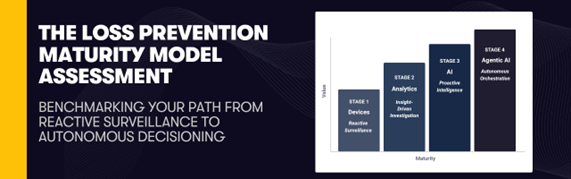
"AI" is the most overused word in loss prevention
right now. Here's a framework that cuts through it.
Many vendors are making claims about AI. Few agree on
what it means, and fewer still can tell you where your
own program actually stands. The Loss Prevention
Maturity Model is a vendor-neutral framework that maps
the evolution of LP technology across four stages
(Devices, Analytics, AI, and Agentic AI), with clear
criteria for each and an honest take on what's genuinely
deployed today versus what's still marketing.
If you haven't yet, take the free self-assessment to
benchmark your program against the model, or read the
full whitepaper for the complete framework.
Take the assessment
Prefer the full read?
Get the whitepaper
Or
watch the on-demand webinar |
|
|
&uuid=(email)) |
|
|
 |
|
|
Cybersecurity Reshapes Retail Loss
Prevention
How Retail IT Leaders Are Using Identity and Access Management to Reduce
Loss Prevention Risks
With attackers adding new weapons to
their arsenals, retailers are turning to other cybersecurity solutions
to ward off attacks and build resilience.
For years, the focus for retail loss prevention has centered
primarily on physical prevention technologies such as surveillance
cameras and point-of-sale monitoring. But with the risk of
cyberattacks, the focus is shifting to loss prevention in retail digital
landscapes. Now, identity and access management (IAM), multifactor
authentication (MFA) and privileged access controls are becoming
essential components of modern loss prevention strategies.
“Historically, retail loss prevention was about securing physical
doors, lockboxes and cash registers. Today, high-value inventory,
financial records, and discount authorizations are all software-defined,”
says Sandeep Kumbhat, vice president and global field CTO at Okta, where
he supports product strategy and solution design for global customers,
focusing on AI security, identity and cybersecurity.
The Verizon Data Breach Investigations Report found that 31% of
breaches begin with software weaknesses, with ransomware specifically
growing in retail, accounting for up to 48% of breaches within the
industry.
Okta’s 2025 Customer Identity Trends Report shows nearly half (46%) of
all digital registration attempts across the globe are classified as
malicious identity attacks. “For retail and e-commerce, this
battlefield is exponentially worse. Bad actors are not just trying
to log in to existing accounts; they are deploying massive, automated
botnets to create fraudulent new accounts at scale.”
Fraudsters use automated credentials to mass-register and drain
signup bonuses, gift card balances and promo rewards. Attackers
deploy shopping bots to buy up high-demand, limited-run inventory
instantly using fake credentials, forcing physical retail shrinkage and
massive digital cart abandonment losses. Using credential stuffing to
take over trusted customer accounts, bad actors fabricate virtual
receipts and process fraudulent returns directly to clean bank cards or
untraceable gift cards.
biztechmagazine.com
Cyber Foes Boosted by AI
Frontier AI tipping the scales toward cyber adversaries
Researchers at Palo Alto Networks’
Unit 42 warn that threat actors are already using AI to accelerate
cyberattacks beyond the abilities of modern defenses.
The advanced use of AI has created a generational shift in the
balance between the ability to protect information and the risk of those
systems being compromised, according to researchers at Palo Alto
Networks (PAN).
The cybersecurity firm, which has conducted extensive research on the
use of frontier AI, opened a window into those findings in a Wednesday
media briefing here. After months of participation in Anthropic’s
Project Glasswing and OpenAI’s Daybreak program, PAN security testers
were able to discover the volume of security vulnerabilities that would
normally take a year to unearth. The danger is that a malicious actor
with these same capabilities could weaponize the security flaws at a
speed at which most modern security defenses cannot compete.
A lone threat actor armed with such AI can engage in sophisticated,
nation-state-level or criminal capabilities without the need for
extensive training or experience, according to Sherrod DeGrippo, VP
threat intelligence at Palo Alto Networks’ Unit 42.
PAN’s Unit 42 was among the first cybersecurity firms to get a
bird’s-eye view of how frontier AI had changed the security landscape.
Nation-state and criminal threat groups had already begun to
incorporate artificial intelligence into their toolkits in prior years,
but these new models raised the stakes to such a new level that only a
few organizations were able to see these capabilities under a more
controlled environment.
cybersecuritydive.com
Big Tech Calls for Better Cyber
Defenses
Time is running out for cyber security, warn top tech firms
A group of 100 firms, including Google, Microsoft, Anthropic and
OpenAI, have signed an open letter calling on countries and
organisations around the world to beef up their cyber defences before AI
grows powerful enough to override them.
The letter warns cyber-attacks which use AI will become both more
widespread and more sophisticated in a matter of months as the
technology rapidly improves.
The group says current "status quo" security measures "won't be enough"
and criticises the "historic under-resourcing" of security around
critical infrastructure.
"We have a limited window to improve cyber defences," the letter
begins.
Other firms to have signed the letter include banks such as Capital One,
payment processors MasterCard and Visa, and other major tech firms
including Adobe, Oracle and IBM.
They call on governments to provide "capable, defensive AI" and
testing to hospitals and water utilities, and on technology companies to
aid such efforts.
bbc.com
What 90 days and a small budget can buy in AI agent security
North Korean remote workers are broadening their job hunt beyond IT |
|
|
 |
|
|
Amazon & Robots
Amazon’s Robot Workforce Is Reshaping E-Commerce Fulfillment
By
the D&D Daily staff
Amazon’s massive fulfillment network is becoming increasingly
automated as the e-commerce giant continues to expand the role of
robotics and artificial intelligence across its operations.
The company now has more than 1 million robots operating throughout
its fulfillment network, a milestone that reflects how dramatically
warehouse operations have changed since Amazon acquired robotics company
Kiva Systems in 2012. Today, robots assist with everything from moving
inventory and sorting packages to picking products and transporting
heavy loads across facilities.
Among Amazon’s latest developments is the next generation of Proteus,
the company’s autonomous mobile robot. Proteus can transport goods
weighing up to 1,300 pounds while navigating around employees and other
obstacles inside facilities. New AI capabilities also allow workers
to direct the robot using conversational language rather than
specialized programming commands.
Amazon is also using artificial intelligence to coordinate its
enormous robotic fleet. Its DeepFleet AI model acts as a
traffic-management system for robots moving through fulfillment centers,
optimizing their routes and reducing congestion. Amazon says the
technology can improve robot travel efficiency by approximately 10%,
helping products move through facilities faster.
Other systems are tackling increasingly complex tasks. Vulcan,
Amazon’s first robot equipped with a sense of touch, can manipulate
products inside storage compartments while detecting how much force it
is applying. Sequoia, another robotic system, helps consolidate and
organize inventory and can store products up to 75% faster than previous
processes.
For the broader e-commerce industry, Amazon’s investment illustrates
how quickly robotics is moving beyond basic warehouse automation.
AI-powered systems are increasingly capable of coordinating equipment,
handling products and making operational decisions in real time.
The result could be fulfillment networks that operate faster, use
space more efficiently and reduce the amount of repetitive lifting
and movement performed by employees.
As retailers continue pushing toward faster delivery speeds, Amazon’s
growing robotic workforce offers a glimpse at what the next generation
of e-commerce fulfillment may look like.
Video: Ukrainian drones target Wildberries e-commerce hub in Russia
Ukrainian drones have again targeted the
Russian online shopping giant Wildberries. Authorities in Russia’s
Tambov region said a major warehouse was entirely destroyed in the
latest attack. At least 12 people have died in a series of strikes on
the company.
Bath & Body Works e-commerce returns to growth
Top tech analyst says people are buying more things on Amazon because of
AI |
|
|
&uuid=(email))
|
|
Los Angeles, CA: South LA Superior Grocers Ransacked by 20 People During
Pre-Dawn Street Takeover
At least 20 people broke into a Superior Grocers store near Manchester
Avenue and San Pedro Street in South Los Angeles early Sunday,
ransacking the shelves during an illegal street takeover that drew LAPD
officers to the scene around 4:30 a.m. Store employees barricaded
themselves on the store's second floor as the crowd swarmed in, and
police took one person into custody. Officers said they still do not
know how much merchandise the thieves made off with, and it remains
unclear when the store will reopen. No injuries were reported in the
break-in.
hoodline.com
Sugar Land, TX: 3 suspects, including a juvenile, allegedly stole $14K
worth of iPads from Sugar Land Target
Three suspects, including a juvenile, were arrested after allegedly
stealing nearly $14,000 worth of iPads from a Target in Sugar Land,
police said. The Sugar Land Police Department said officers responded to
a theft in progress at the Target store at 16300 Southwest Freeway on
Tuesday at about 7 p.m. Surveillance video showed the suspects breaking
the glass of a store display case, removing several items, and putting
them into a garbage bag before leaving the store, police said. Officers
said they found the suspects attempting to leave the parking lot in a
black passenger vehicle and detained the front passenger. A passenger in
the backseat tried to flee on foot, but was apprehended, police said.
abc13.com
Man with 18 theft convictions arrested again at Tampa discount store
Deputies responded to a shoplifting call at dd’s DISCOUNTS on East
Fletcher Avenue at 7:03 p.m. Sunday. Deputies say a complainant reported
that 45-year-old Demario Card was trying to leave the store with more
than $400 in stolen items. When confronted, deputies say Card handed
back some of the merchandise but still walked out with $100 worth of
items before being stopped again. When deputies arrived, they arrested
Card, who was also found in possession of cocaine.
fox13news.com
Waller County, TX: Marijuana and makeup bust: Over $9k in stolen
merchandise recovered, Waller County Sheriff's Office says
Two wanted persons were taken into custody after a traffic stop led to
the discovery of cosmetics and cannabis inside the suspects' vehicle.
According to the Waller County Sheriff's Office, Flock cameras were used
to search for a suspect vehicle after a tip from the Sealy Police
Department. Deputies were able to stop the suspects' car and found
marijuana and a large amount of cosmetic merchandise that was believed
to be stolen.
abc13.com
Cleveland, OH: Football members from Glenville HS allegedly steal over
$4K worth of various items from Dick's Sporting Good
An investigation is underway after members of the Glenville High School
football team allegedly stole thousands of dollar's worth of various
items from a Dick's Sporting Goods just outside of Columbus on Thursday,
according to the Grove City Division of Police. Grove City police said
around 7:26 p.m., officers responded to the store at 1656 Springtown
Road for a theft report. Staff reported juveniles ranging from the ages
of 15 to 20 allegedly stole a total of $4,552.04 worth of merchandise
from the Dick's Sporting Goods store, police said. Grove City police
said staff believed the individuals were players on the Glenville High
School football team.
news5cleveland.com
&uuid=(email))
|
|
|
|
&uuid=(email))
|
|
|
|

|
|
|
Shootings & Deaths
Akron, OH: Man killed in shooting at Akron convenience store
Akron police are investigating an early morning shooting on Sunday that resulted
in the death of a 63-year-old man at a South Arlington Street gas station.
Police responded to a call about a shooting at the Circle K at 940 South
Arlington St., where witnesses reported hearing multiple gunshots. Responding
officers found the man, who had been shot in the face. He was pronounced
deceased at the scene.
beaconjournal.com
Shelby County, TN: Man injured, Starbucks hit by gunfire in Cordova shooting
A man was injured and a nearby Starbucks was struck by gunfire during a shooting
Saturday afternoon in Cordova, according to the Shelby County Sheriff’s Office.
Deputies responded to the 1100 block of Houston Levee Road near Macon Road
around 2:33 p.m. following reports of a shooting with injuries outside an
AutoZone. Before deputies arrived, an adult man who had been shot was taken to
Methodist Hospital in Olive Branch. The sheriff’s office said his injuries are
non-critical. During the investigation, deputies discovered that a nearby
Starbucks building had also been struck by gunfire.
wreg.com
Clay County, FL: Clay police arrest man for robbery after a gunshot prompted a
Publix evacuation Friday night
The Clay County Sheriff’s Office said it has arrested a 19-year-old man for a
robbery involving a firearm in a restroom at Publix supermarket on Blanding
Boulevard on Friday. Zion Jay Simmons, 19, was arrested for robbery after
witnesses reported several male subjects running out of the store restroom
following a single gunshot. Out of an abundance of caution, the Orange Park
store was evacuated and secured, police said.
actionnewsjax.com
Columbus, OH: 1 hurt in C-Store shooting on Columbus' north side
Robberies, Incidents & Thefts
Bronx, NY: 13-year-old stabbed in broad daylight attack in the Bronx
A teenage boy was stabbed in broad daylight outside a Bronx supermarket Saturday
and left wounded, police sources said. The 13-year-old was stabbed in the
stomach outside C-Town at 1612 Westchester Avenue in the Bronx’s Soundview
neighborhood at 5:23pm, police sources said. He was taken to Jacoby Hospital on
Pelham Parkway by EMS workers after the assault and is in stable condition.
nypost.com
Calgary, AB, Canada: Man faces multiple charges after stabbing near entrance to
Marlborough Mall
A man has been charged following a stabbing that took place near the entrance to
Marlborough Mall Saturday night. At 7:05 p.m., police responded to reports of a
fight between two men, which escalated when one man stabbed the other in the
neck. Arriving officers were able to locate the suspect and arrested him. The
victim was transported to hospital with serious, life-threatening injuries but
was later upgraded to stable condition. No one else was injured. A 32-year-old
man was charged with aggravated assault, possessing a dangerous weapon, and
failing to comply with a probation order. The accused is currently at CPS Arrest
Processing.
guelph.ctvnews.ca
Miami, FL: Update: New surveillance video shows a hooded suspect ignite an
explosion at a Miami-Dade gas station
New video provided by the social media account "Only in Dade" captured an
early-morning blast at a Miami-Dade gas station earlier this month. The
explosion happened on August 13 at pump No. 2 of a Chevron station at the corner
of Bird Road and Southwest 87th Avenue, Miami-Dade Sheriff's Office said. The
footage shows a hooded individual placing a bag on top of the gas pump before an
explosion erupts, knocking the person several feet backward. At one point, the
individual appears to lie on the ground for several seconds before getting up
and running from the scene, according to the video. Investigators said the
suspect arrived at the gas station carrying a sign that read, “Cuban Lives
Matter. End Embargo.” The Miami-Dade Sheriff’s Office released a flyer on August
18 requesting information on the suspect seen in the video. No additional
details about the case have been released.
nbcmiami.com
Houston, TX: Houston postal carriers charged in alleged $23 million check-theft
scheme
|
|
|
|

•
C-Store – Socorro, TX
– Armed Robbery
•
C-Store – Westminster,
SC – Armed Robbery
•
C-Store – Cloquet, MN
– Armed Robbery
•
Clothing – Wilkes
Barre, PA – Robbery
•
Discount – Tampa, FL –
Robbery
•
Grocery – Los Angeles,
CA – Robbery
•
Jewelry - Winston-Salem, NC - Robbery
•
Jewelry - Trumbull, CT – Robbery
•
Restaurant – San
Antonio, TX – Armed Robbery
•
Sport – Columbus, OH –
Robbery
•
Target – Sugar Land,
TX - Robbery
•
Tobacco – Punta Gorda,
FL – Burglary
•
Walmart – Dodgeville,
WI – Robbery |
|
|
Daily Totals:
• 12 robberies
• 1 burglary
• 0 shootings
• 0 killed |
|
|
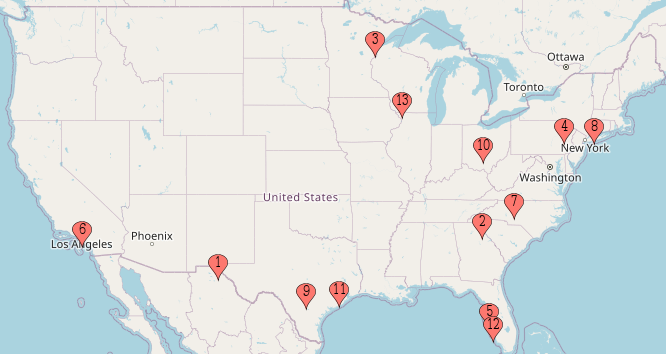
Click map to enlarge
|
|
|
|
|
&uuid=(email)) |
|
|
|

&uuid=(email)) |
|
|
Featured Job Spotlights
|
Help Your Colleagues - Your Industry - Build a
'Best in Class' Community
|
 |
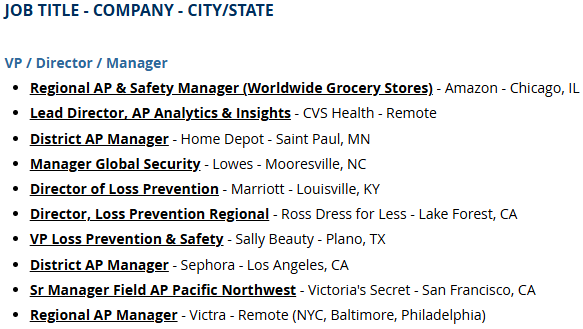
VP Loss Prevention & Safety
Plano, TX
Leads the enterprise-wide strategy for asset protection, loss
prevention, safety, security, and environmental compliance. Accountable for
minimizing financial and operational risk, strengthening internal controls, and
ensuring regulatory compliance across all locations...
|
 |
Lead Director, Asset Protection Analytics & Insights
Remote
The Director of AP Analytics and Investigations is responsible for
leveraging analytics, technology, and investigative strategies to support Asset
Protection operations, investigations, and risk mitigation efforts across the
organization...
|
Featured Jobs
To apply to any of today's Featured Jobs,
Click Here
 |
|
View Featured
Jobs
|
Post
Your Job
|
|
|
|
|
|

Insight,
humor & heart from
one of LP's most trusted voices |
|
|
After Thirty Years Around This Industry,
Here's What Still Impresses Me...
It's not the newest
technology. It's not the biggest booth. It's not the flashiest
presentation. It's watching good people...from retailers, solution
providers, and industry organizations, genuinely trying to help each
other solve hard problems. That's one thing this industry has always
done remarkably well. And if we're smart, it's one tradition we'll never
replace.
Follow this space every day to see more of 'Hedgie's Hot Takes' |
|
|
|
Not getting the Daily? Is it ending up in your spam folder?
Please make sure to add d-ddaily@downing-downing.com to your contact list,
address book, trusted sender list, and/or company whitelist to ensure you
receive our newsletter.
Want to know how?
Read Here |
|
FEEDBACK
/
downing-downing.com
/
Advertise with The D&D Daily |
|
 |
&uuid=(email))



&uuid=(email))
&uuid=(email))